
 0
0
 0
0
If you’ve ever walked into your hallway to find three coats slumped over the bannister, a school bag abandoned on the floor, and a single overworked hook groaning under the weight of everyone’s outerwear, you already know why coat hook placement matters. It isn’t just about tidiness. The right coat hook placement changes how your whole entryway functions — how quickly you can get out the door, how welcoming your hallway feels, and how much daily nagging (“just hang it up!”) you can avoid altogether.
The good news is that working out where to put coat hooks isn’t complicated once you understand a few simple principles. In this guide, we’ll walk through ten practical placement ideas — from classic hallway coat hooks to clever coat storage ideas for small spaces — along with the heights, spacing, and fixings you need to get it right the first time.
Why Coat Hook Placement Matters
Coat hooks seem like a small detail, but poor placement is one of the most common reasons a hallway feels chaotic. Hooks positioned too high get ignored (particularly by children), hooks placed too close together turn into a tangled knot of sleeves, and a single hook by the front door is rarely enough for a busy household.
Good coat hook placement solves three problems at once:
- It gives every coat, bag, scarf and umbrella an obvious “home”
- It keeps the floor and bannister clear
- It makes tidying up an automatic habit rather than a chore
With that in mind, let’s look at exactly where wall hooks for coats work best.
10 Practical Placement Ideas for Coat Hooks
1. Directly Beside the Front Door
The single most useful spot for entryway coat hooks is the wall immediately beside your front door — ideally the side you naturally turn towards as you come in. This is prime real estate because it catches coats before they ever reach the living room. A row of two to four hooks here handles the coats in daily rotation, while bulkier or seasonal items can live further down the hall.
2. Along an Empty Hallway Wall
If your hallway has a long, uninterrupted stretch of wall, it’s an obvious candidate for hallway coat hooks. A row of evenly spaced hooks along this run gives every family member their own spot, which is one of the simplest hallway storage ideas going. It also spreads the weight of coats across several fixings rather than piling everything onto one or two hooks.
3. Behind the Front Door Itself
Often overlooked, the back of the front door is a brilliant spot for one or two hooks — perfect for a dressing gown, an umbrella, a dog lead, or the coat you wear most days. Just make sure the door can still open and close fully once a coat is hanging there.
4. Inside a Coat Cupboard or Understairs Space
If you’re lucky enough to have an understairs cupboard, lining the inside with hooks turns dead space into proper coat storage. This keeps outerwear completely out of sight, which is ideal if you prefer a clean, minimal hallway rather than coats on permanent display.
5. At Child Height, Lower Down the Wall
One of the most practical coat hook ideas for family homes is a second, lower row of hooks specifically for children. Fitting hooks at roughly 90–110cm from the floor means younger family members can hang up their own coats and bags without help — which, in practice, means far fewer coats left in a heap by the door.
6. In the Boot Room or Utility Room
If your home has a boot room, utility room, or back porch, this is often a better home for wet or muddy coats than the main hallway. Wall mounted coat hooks here keep damp outdoor gear away from carpets and radiators, and they’re especially useful for waterproofs, dog walking coats, and school PE kit.
7. Above a Hallway Bench or Shoe Storage
Pairing hooks with a bench or shoe rack creates a proper “landing zone” for coming and going. You sit down, take off your shoes, and hang your coat directly above — no extra steps involved. This combination is one of the most functional coat storage ideas for busy households, as it keeps coats, shoes, and bags all organised in one compact zone.
8. On the Back of Bedroom Doors
Not every coat needs to live downstairs. A hook on the back of a bedroom door is a neat solution for dressing gowns, occasional-use jackets, or the coat you’re planning to wear tomorrow. It’s also a smart option in shared houses or student accommodation, where hallway space is limited.
9. In a Row of Individual Hooks for Small Hallways
For narrow or compact entryways, individual coat hooks fitted in a tight row take up far less visual and physical space than a bulky coat stand. This is one of the most effective coat storage ideas for small spaces — a slim row of hooks adds storage without making the hallway feel cramped.
10. On a Multi-Hook Rail Rather Than Scattered Single Hooks
Rather than fitting several individual hooks at slightly different heights (which quickly looks messy), consider a single coat hook rail with multiple pegs evenly spaced along it. This gives you the organisation of several hooks with the neat, uniform look of one fitting — a popular choice for anyone wanting hallway coat storage that still looks smart.
Also Read: How to Decorate with Wall Mounted Coat Hooks?
How High Should Coat Hooks Be?
Once you’ve chosen your spots, height is the next detail worth getting right. As a general rule:
- Adult hooks: around 150–160cm from the floor to the centre of the hook. This keeps most coats clear of the ground while staying within easy reach.
- Above a bench: if hooks sit above a hallway bench or shoe storage, mount them roughly 60–75cm above the seat, so coats don’t drape onto the bench itself.
- Child hooks: around 90–110cm from the floor, adjusted to the height of the children using them.
- Tall households: if most of the household is over 6ft, it’s worth raising adult hooks slightly, to around 165–170cm.
How Far Apart Should Coat Hooks Be?
Spacing is just as important as height. As a rule of thumb, leave 25–30cm between each hook, centre to centre. This gives a coat enough room to hang without bunching into its neighbour, while still making efficient use of the wall. If you’re fitting hooks specifically for bulky winter coats, it’s worth erring towards the wider end of that range.
A Note on Installing Coat Hooks Properly
Placement only works if the fixing does its job. Most walls in a typical hallway are either plasterboard or masonry, and each needs a different approach:
- On plasterboard, always use proper plasterboard fixings or, better still, screw into the timber stud behind the board wherever possible — coats add up to more weight than people expect.
- On brick or masonry walls, use wall plugs rated for the weight of a loaded hook, especially if several coats will hang there at once.
- Always check with a cable and pipe detector before drilling, and use a spirit level to keep a row of hooks perfectly aligned.
If you’d like the full step-by-step method, our dedicated installation guide covers fixings, tools, and marking out a straight row in more detail.
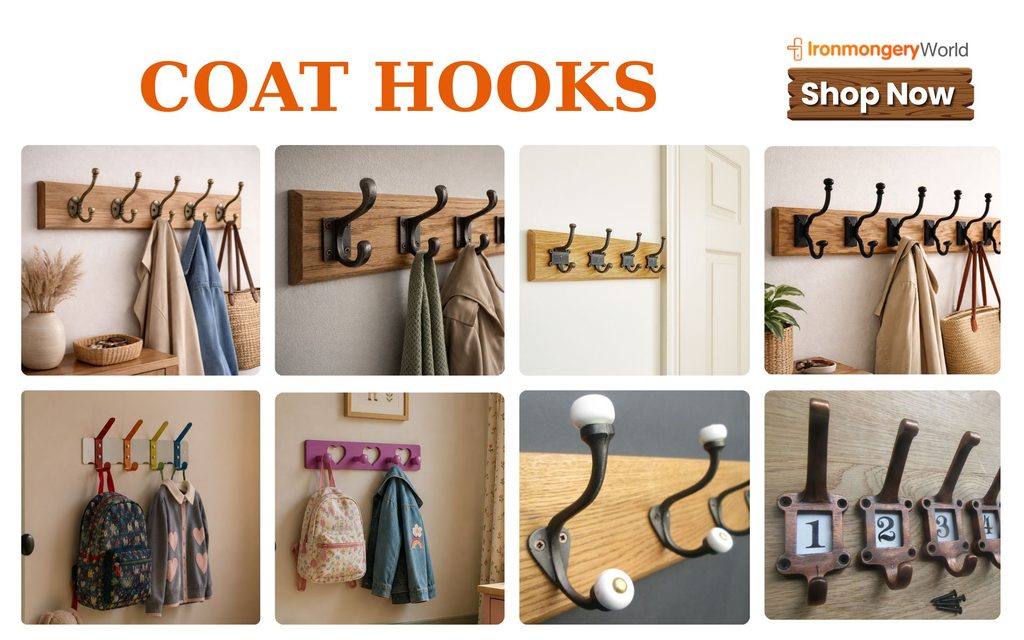
Choosing the Right Hooks for Each Spot
Placement and hardware go hand in hand. A single heavy-duty hook by the front door needs to cope with a wet winter coat and a school bag every single day, while a decorative hook on a bedroom door might only ever hold a dressing gown. Ironmongery World’s range of coat hooks includes everything from simple wall mounted coat hooks in chrome and matt black through to vintage-style and cast iron designs, so you can match the hook to both the room and the job it needs to do.
Bringing It All Together
Good coat hook placement isn’t about squeezing in as many hooks as possible — it’s about matching the right hook, in the right spot, at the right height, to the way your household actually moves through the front door. Start with the highest-traffic spot (usually right beside the door), add a lower row for children if needed, and use boot rooms, cupboards, or bedroom doors to catch the overflow. Get the spacing and height right, and even a small hallway can stay clear, calm, and properly organised.
FAQs: Coat Hook Placement, Height, Spacing and Fixings
How to install coat hooks?
Mark your chosen height and spacing with a pencil and spirit level, check for cables or pipes, then drill pilot holes suited to your wall type. Fit plasterboard fixings or wall plugs as needed, screw the hook base in place, and check it’s secure before hanging anything heavy on it.
How to install coat hooks on a wall?
Decide on hook height and spacing first, then use a spirit level to mark each fixing point in a straight, even line. Drill into a stud where possible, or use appropriate wall plugs for masonry or plasterboard fixings. Tighten each screw fully so the hook can’t twist under weight.
How high should coat hooks be?
For most adults, fit coat hooks around 150–160cm from the floor to the centre of the hook, keeping coats clear of the ground while staying within easy reach. Above a hallway bench, mount them 60–75cm higher than the seat. For children, lower this to roughly 90–110cm.
How far apart should coat hooks be?
Space coat hooks around 25–30cm apart, centre to centre, so each coat has room to hang without bunching into its neighbour. For bulkier winter coats or padded jackets, aim towards the wider end of that range so sleeves don’t overlap, crush, or trap each other when hung together.
How many coat hooks do I need?
Allow roughly one to two hooks per household member, plus a couple of spares for guests, bags, or dog leads. A busy family hallway often works best with four to six hooks split between adult and child height, rather than cramming everyone onto one crowded row.
Where should coat hooks be placed?
The most useful spot is the wall directly beside your front door, catching coats before they reach the rest of the house. Additional hooks work well along a hallway wall, inside a cupboard, in a boot room, or above a bench, depending on how much storage your household needs.
Where to put coat hooks?
Start with the wall nearest your front door for everyday coats, then add hooks further along the hallway, behind the door itself, or in a utility room for wet outerwear. Bedrooms and understairs cupboards make good spots for overflow, seasonal coats, or items you use less often.
What height should coat hooks be?
Adult coat hooks typically sit at 150–160cm from the floor, keeping most coats off the ground while remaining easy to reach. Taller households may prefer 165–170cm. Children’s hooks should be lower, around 90–110cm, so younger family members can hang up their own coats without help.
What is the best height for coat hooks?
There isn’t one fixed answer, as it depends on who’s using them. Around 150–160cm suits most adults, while a lower row at 90–110cm suits children. Above a bench, keep hooks 60–75cm higher than the seat so coats don’t drape onto anyone sitting down.
How to arrange coat hooks?
Group hooks by user or purpose rather than fitting them randomly. Keep adult hooks in one even row, add a lower row for children if needed, and space everyday hooks nearest the door with occasional-use hooks further along. A straight, evenly spaced line always looks neater than staggered heights.
How to space coat hooks?
Measure and mark each fixing point 25–30cm apart, centre to centre, using a spirit level to keep the row straight. Consistent spacing prevents coats overlapping and makes the finished result look intentional rather than improvised, especially when fitting three or more hooks along the same wall.
How to hang coat hooks on a wall?
Mark your height and spacing, identify whether you’re fixing into plasterboard, brick, or a timber stud, and choose fixings to match. Drill pilot holes, insert wall plugs if needed, and screw the hook securely in place, checking each one is level before moving on to the next.
Can you put coat hooks on plasterboard?
Yes, plasterboard walls are a common spot for coat hooks, provided you use proper plasterboard fixings rated for the expected weight. Where possible, screwing into the timber stud behind the board gives extra strength, particularly for hooks that will regularly hold heavier winter coats or laden bags.
Can coat hooks go on drywall?
Coat hooks can be fitted to drywall using suitable cavity fixings designed to spread the load across the board. For hooks carrying heavier or multiple coats, locating and screwing into the stud behind the drywall gives a far more secure, long-term fixing than relying on the board alone.
What fixings do I need for coat hooks?
This depends on your wall type. Solid brick or masonry needs wall plugs matched to the screw size, while plasterboard or drywall needs cavity fixings rated for the hook’s expected load. Wherever possible, fixing into a timber stud gives the strongest and most reliable result for coat hooks.
How much weight can a coat hook hold?
This varies by hook design and fixing method, but most household coat hooks are built to comfortably support one or two coats when properly fixed. The fixing matters as much as the hook itself, so always match wall plugs or cavity fixings to the load you expect.
How many coats can go on one hook?
Most single coat hooks are designed to comfortably hold one to two coats without strain. Loading several heavy coats onto one hook puts pressure on both the hook and its fixing, so for busy households it’s better to fit additional hooks than overload a single point.
What size coat hooks do I need?
Hook size depends on what you’re hanging. Slimmer hooks suit lighter jackets, scarves, or dressing gowns, while wider, deeper hooks cope better with bulky winter coats or bags hung alongside them. If several items share one hook regularly, choose a larger, sturdier design built for the load.
Are coat hooks better than coat racks?
It depends on your space. Wall mounted coat hooks take up no floor space and suit hallways, boot rooms, and small entryways, while freestanding coat racks suit larger, open hallways or rented homes where drilling isn’t possible. Many households happily use both, in different rooms.
How do you organise coat hooks?
Assign hooks by person or purpose so everyone knows their spot, keeping everyday coats nearest the door and occasional-use items further along. Pairing hooks with a bench or shoe storage, and adding a lower row for children, keeps busy hallways tidy without constant reminders to hang things up.